The Government of Ghana has announced a set of temporary measures aimed at cushioning consumers against rising fuel prices, following increased volatility on the international petroleum market. The intervention is intended to ease the financial pressure on households, transport operators, and businesses facing higher energy costs.
Effective April 16, 2026—the start of the next pricing window—the State will absorb GH¢2 per litre on diesel and GH¢0.36 per litre on petrol. The move is designed to directly reduce ex-pump prices and limit the ripple effects of fuel price increases on transportation and the broader economy.
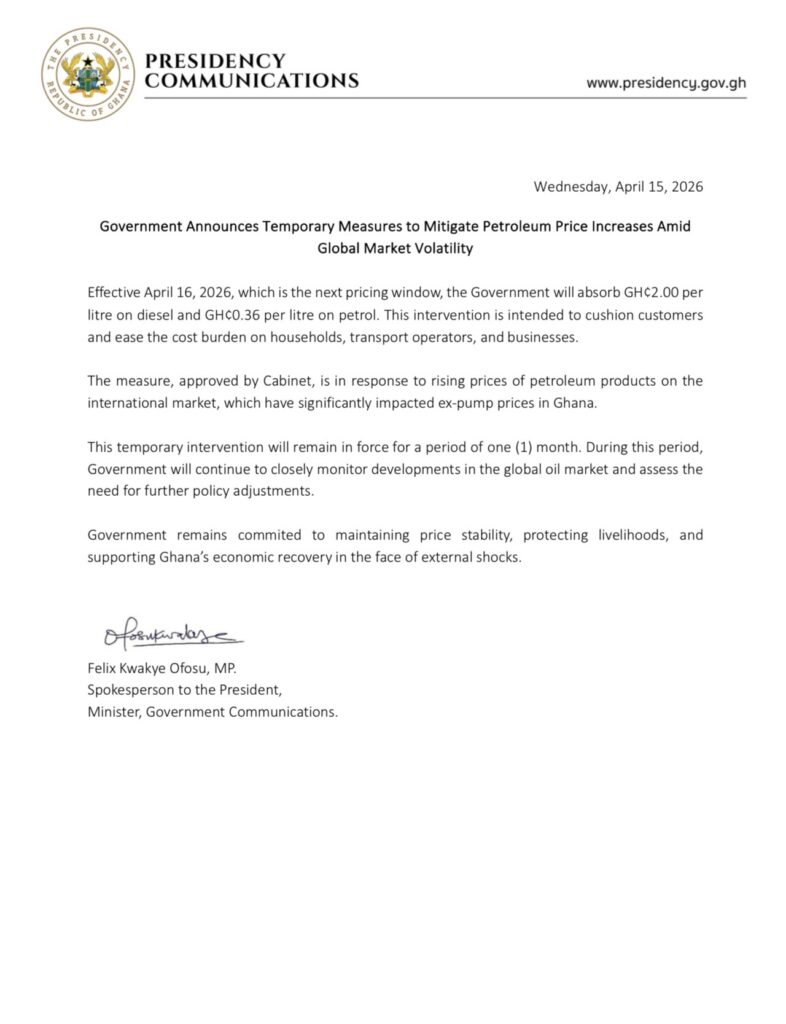
In a press statement issued on Wednesday, April 16, the Government Communications Minister, Felix Kwakye Ofosu, explained that the decision was taken in response to sharp increases in global oil prices. These international price movements have significantly influenced local fuel prices, contributing to rising transportation costs and increased cost of living.
The measure, which has received Cabinet approval, will remain in force for an initial period of one month. During this time, government says it will closely monitor developments in the global oil market and assess whether additional policy interventions may be necessary to sustain price stability.
“Effective April 16, 2026, which is the next pricing window, the Government will absorb GH¢2 per litre on diesel and GH¢0.36 per litre on petrol.
"This intervention is intended to cushion customers and ease the cost burden on households, transport operators, and businesses,” the statement said.
Government further indicated that the move forms part of a broader strategy to stabilise prices and protect livelihoods amid external economic pressures. Authorities emphasised that maintaining affordability of essential commodities, such as fuel, remains critical to supporting economic recovery and ensuring social stability.
“Government remains committed to maintaining price stability, protecting livelihoods, and supporting Ghana’s economic recovery in the face of external shocks,” the statement added.
The intervention is expected to provide short-term relief to consumers while authorities evaluate longer-term solutions to manage the impact of global fuel price fluctuations on the domestic economy.

.jpg)