Ghana loses nearly $600m in petroleum revenue as earnings drop by 43.27% in 2025—PIAC report
.jpg)
Ghana’s petroleum sector is under growing strain following a significant decline in oil revenues, with the country losing nearly $600 million within a year, according to the latest report from the Public Interest and Accountability Committee (PIAC).
The report reveals that total petroleum receipts dropped sharply by 43.27%, falling from $1.36 billion in 2024 to $770.27 million in 2025. This represents one of the steepest annual declines in recent years and underscores widening vulnerabilities in Ghana’s upstream oil and gas industry.
Sustained Drop in Oil Production
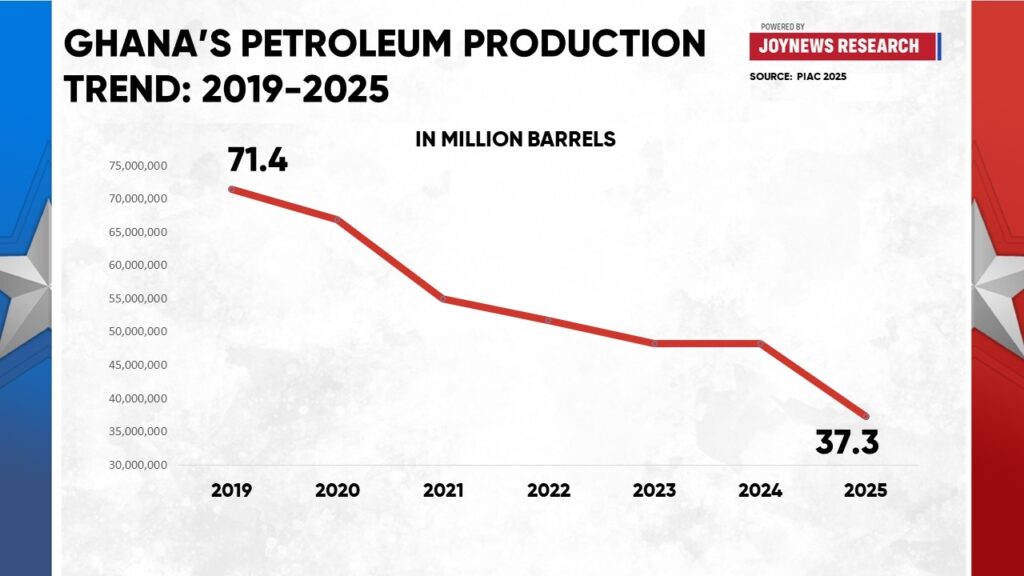
PIAC attributes the revenue slump largely to a continuous decline in crude oil output, which has now fallen for six consecutive years. Production decreased from 71.44 million barrels in 2019 to 37.3 million barrels in 2025, representing an average annual decline of about 9%.
The report links this downward trend to several structural and operational factors, including:
Maturing oil fields nearing depletion
Natural reservoir decline
Technical and operational constraints
Limited investment in new upstream exploration
These challenges, PIAC warns, are gradually weakening Ghana’s long-term petroleum production capacity.
Operational Inefficiencies and Field Performance Concerns
The report also highlights inefficiencies in field operations, particularly high levels of gas reinjection. In the TEN field, gas reinjection reached 81%, a figure that signals constraints in gas utilization and reduced production efficiency.
Compounding the issue, the TEN field recorded no revenue inflows in 2025, further worsening the overall decline in petroleum earnings.
PIAC notes that Ghana’s petroleum revenue base remains overly dependent on just two major fields—Jubilee and SGN—leaving the country exposed to significant fiscal risks in the event of production shocks or price fluctuations.
DACF Shortfall and Legal Compliance Issues
A major concern raised in the report is non-compliance with statutory revenue distribution rules.
Only 0.43% of the Annual Budget Funding Amount (ABFA) was transferred to the District Assemblies Common Fund (DACF), far below the legally required minimum of 5%.
PIAC describes this as a serious breach of both statutory and constitutional provisions under the Petroleum Revenue Management Act (PRMA), warning that such deviations undermine equitable development and local government financing.
The report also reveals that $434.55 million earmarked for infrastructure under the government’s Big Push programme remained unused and parked in a suspense account throughout the year. PIAC says this raises concerns about planning inefficiencies and weak public financial management systems.
Transparency and Governance Concerns
PIAC further raises concerns about transparency in petroleum revenue management, citing:
Limited stakeholder engagement
Insufficient public disclosure on PRMA amendments
Weak accountability in revenue reporting
These issues, the committee argues, weaken public trust and reduce oversight of petroleum income management.
Petroleum Funds Show Growth, but Risks Persist
Although the total value of the Ghana Petroleum Funds increased slightly from $1.46 billion to $1.55 billion, PIAC cautions that this masks deeper governance and compliance issues.
A key concern is the capping of the Ghana Stabilization Fund at $100 million, which PIAC says was not applied in line with legal requirements.
While the Heritage Fund recorded modest growth, it was offset by weaknesses in the Stabilization Fund, which is designed to cushion the economy during revenue shocks.
GNPC and Subsidiary Accountability Issues
The report also raises red flags over the financial position of the Ghana National Petroleum Corporation (GNPC).
Key findings include:
GNPC receipts fell by 61.55% due to reduced inflows and policy adjustments
Rising cash call obligations, particularly linked to the TEN field
$561.65 million in petroleum revenue unaccounted for by Explorco, GNPC’s subsidiary
PIAC warns that these gaps raise serious questions about transparency, oversight, and financial reporting within state-owned petroleum entities.
Energy Sector Debt and Structural Risks
The Ghana National Gas Limited Company (GNGLC) also remains a source of concern. Although its debt has slightly declined, it still stands at $620.54 million.
PIAC notes that tariff distortions and weak pricing structures in the gas sector continue to create risks of revenue leakage and instability across the gas-to-power value chain, threatening energy security.
PIAC Calls for Urgent Reforms
To address the widening challenges, PIAC is urging comprehensive reforms across the petroleum and energy sectors.
Key Recommendations:
Production and Investment
Improve investment attractiveness in upstream exploration
Develop a medium-term strategy to enhance reservoir connectivity in the TEN field
Extend the productive lifespan of existing fields
Revenue Management
Ensure full compliance with DACF allocation requirements
Align PRMA provisions with the 1992 Constitution
Release $434.55 million to the Ministry of Roads and Highways for infrastructure delivery
Transparency and Accountability
Publish detailed ABFA-funded project information
Improve branding and tracking of petroleum-funded projects
Revive stalled PRMA amendment processes
Develop a long-term national petroleum revenue strategy
Institutional Oversight
Strengthen monitoring of GNPC and Explorco
Ensure accountability for $561.65 million in unaccounted funds
Energy Sector Stability
Clarify industrial gas pricing policy
Implement a time-bound plan to reduce GNGLC’s debt under the Cash Waterfall Mechanism

Aikines Anyomi

News
Food
Politics
Technology
About Us
Download Our Mobile App

