Mahama calls for stronger collaboration with chiefs to curb land-related conflicts

President John Dramani Mahama has expressed concern over the growing influence of chieftaincy and land disputes in driving conflicts across Ghana, calling for stronger collaboration between government and traditional authorities to help address the challenge.
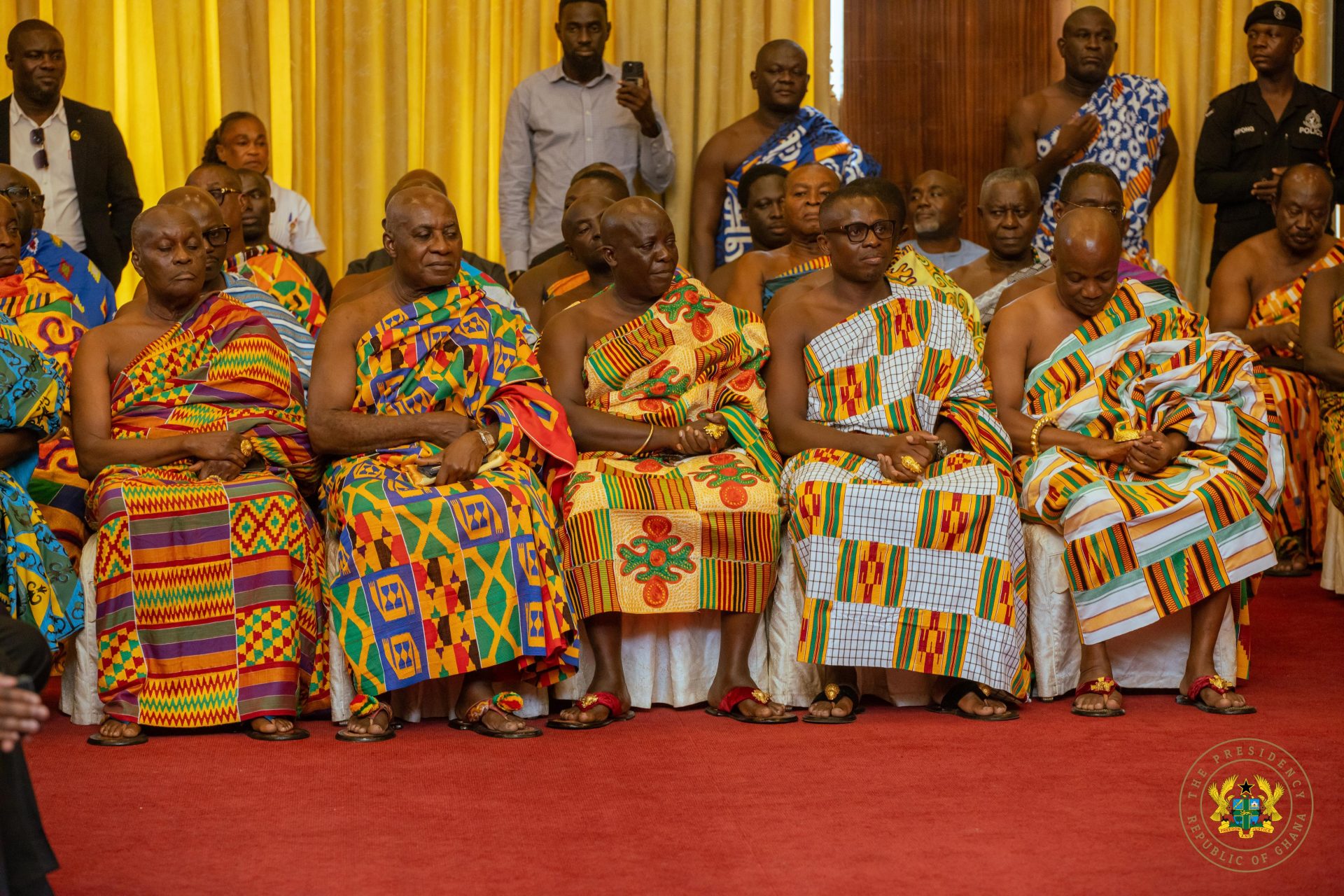
He made the remarks during a courtesy call by the Eastern Regional House of Chiefs, where discussions focused on security, development, and the evolving role of traditional leadership in national governance.
The President noted that disputes relating to chieftaincy succession and land boundaries continue to be major sources of tension in several parts of the country, undermining peace and local development efforts.
“One area of concern is security and conflict, and we realise that a major contributor to conflicts across the country is the chieftaincy institution and issues of land boundaries,” he said.
He explained that while government recognises the seriousness of these disputes, its ability to intervene directly is limited by constitutional provisions.
According to him, the 1992 Constitution of Ghana restricts government involvement in chieftaincy matters, assigning responsibility for resolving such disputes to traditional authorities themselves.
“The 1992 Constitution barred government from interfering in chieftaincy matters and said that issues of chieftaincy disputes should be handled by the chiefs themselves,” he said.
“Government only intervenes when law and order breaks down, but we cannot interfere in the customs and usages of the chieftaincy institution.”
Despite these constitutional limitations, President Mahama stressed the need for closer cooperation between the state and traditional leadership structures, including the National House of Chiefs and regional houses of chiefs, to help prevent and resolve conflicts more effectively.
“We believe that it is something we need to work on with the National House of Chiefs and the Regional Houses of Chiefs,” he added.
Turning to the economy, the President stated that Ghana is approaching a key milestone as it prepares to conclude its programme with the International Monetary Fund (IMF).
“We are coming out of the IMF programme. It is coming to an end, with the final review expected next month,” he said.
He emphasized that despite exiting the programme, government remains committed to maintaining fiscal discipline in order to preserve macroeconomic stability and consolidate recent gains.
“But beyond the programme, we intend to keep the fiscal discipline that has resulted in the stabilisation of the macroeconomic environment,” he noted.
On infrastructure, President Mahama announced plans to expand healthcare delivery across Ghana’s newly created regions through the construction of regional hospitals. He indicated that work on some of these facilities will begin within the year.
“The other new regions that are going to receive regional hospitals… we are starting with three of the regional hospitals this year, and next year we will cut sod for the next three,” he disclosed.
He also addressed delays affecting the Eastern Regional Hospital project, assuring stakeholders that efforts were underway to restart and complete the facility.
“The Eastern Regional Hospital stalled a bit. I have asked that the contractor go back to the site and we pay him so that we can complete it,” he said.
In the education sector, the President revealed plans to accelerate the establishment of a new university aimed at expanding access to tertiary education, particularly in science and technology fields.
“Recently I was in Korea, and we discussed the issue of the University of Engineering, Science and Agriculture in Bonsu,” he said.
“That is an institution we are activating as quickly as possible so that we can create more room for our young people who are seeking tertiary educational opportunities.”

Aikines Anyomi

News
Food
Politics
Technology
About Us
Download Our Mobile App

