Xenophobic attacks: We count on your leadership to resolve this - Ablakwa tells South African President Ramaphosa

Ghana’s Minister for Foreign Affairs, Samuel Okudzeto Ablakwa, has called on South African President Cyril Ramaphosa to take decisive leadership in ending recurring xenophobic attacks against African nationals living in South Africa.
Mr Ablakwa’s comments came after President Ramaphosa publicly condemned recent violent protests and attacks targeting foreign nationals in parts of South Africa.
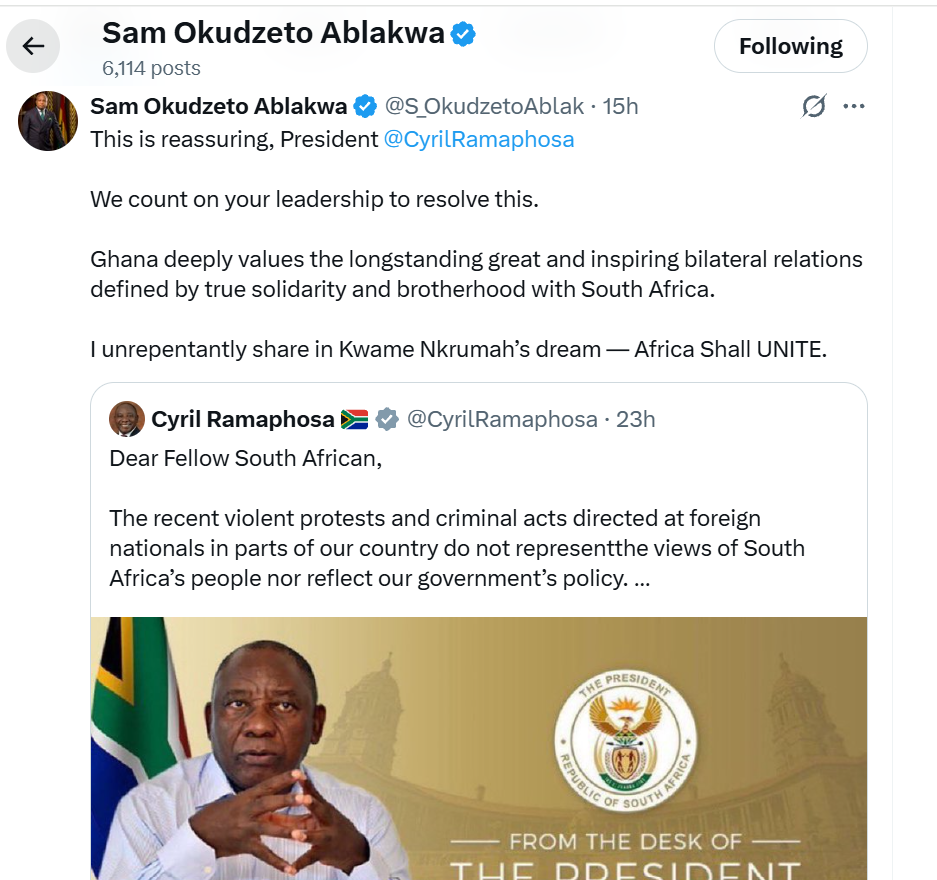
In a message posted on X, formerly Twitter, President Ramaphosa stated that the attacks do not reflect the values of South Africans or the policies of his government.
“Dear Fellow South African, the recent violent protests and criminal acts directed at foreign nationals in parts of our country do not represent the views of South Africa’s people nor reflect our government’s policy,” President Ramaphosa wrote.
Responding to the statement, Mr Ablakwa welcomed the South African President’s remarks and expressed confidence in his ability to address the situation.
“This is reassuring, President Cyril Ramaphosa. We count on your leadership to resolve this,” the Ghanaian Foreign Minister wrote on X.
He further emphasized the strong historical and diplomatic ties between Ghana and South Africa, describing the relationship between the two countries as one built on solidarity, unity, and brotherhood.
“Ghana deeply values the longstanding great and inspiring bilateral relations defined by true solidarity and brotherhood with South Africa,” he stated.
Mr Ablakwa also invoked the Pan-African vision of Ghana’s first President, Kwame Nkrumah, reaffirming his belief in African unity.
“I unrepentantly share in Kwame Nkrumah’s dream — Africa Shall UNITE,” he added.
The latest diplomatic engagement follows Ghana’s formal petition to the African Union requesting that the issue of xenophobic attacks in South Africa be included on the agenda of the upcoming Eighth Mid-Year Coordination Meeting of the AU.
The high-level meeting, which will be attended by African Heads of State and Government, is scheduled to take place from June 24 to June 27, 2026, in El Alamein.
In a formal communication submitted to the African Union, Mr Ablakwa described the issue as a matter of urgent continental concern requiring collective African attention and action.
“I have the honour, on behalf of the Government of the Republic of Ghana, to respectfully submit for inclusion on the agenda of the Eighth Mid-Year Coordination Meeting of the African Union, as a matter of urgent continental interest, the topic of Xenophobic Attacks in the Republic of South Africa against African Nationals,” he stated.
The Foreign Affairs Minister expressed deep concern over the repeated incidents of violence against foreign African nationals in South Africa, noting that the attacks have resulted in loss of lives, destruction of businesses and investments, and heightened fear among African migrants living in the country.
According to him, the persistence of xenophobic violence threatens not only the safety and wellbeing of African nationals but also the ideals of African solidarity and continental integration championed by the African Union.
Mr Ablakwa said the recurring attacks are particularly troubling considering the historic support many African countries, including Ghana, offered South Africa during the anti-apartheid struggle and the country’s democratic transition.
“This development is especially concerning when viewed in the light of the longstanding solidarity demonstrated by African states in support of the struggle against apartheid and South Africa’s subsequent democratic transformation,” he noted.
While reaffirming Ghana’s respect for South Africa’s sovereignty, Mr Ablakwa stressed that attacks targeting fellow Africans undermine the shared principles of unity, brotherhood, and cooperation that African nations continue to promote under the African Union framework.
Political analysts say Ghana’s decision to elevate the matter to the African Union level signals growing concern among African governments over the resurgence of xenophobic violence and its implications for regional integration, trade, migration, and continental peace.
The issue is expected to generate significant discussion during the upcoming AU meeting as African leaders seek sustainable solutions to protect migrants and strengthen unity across the continent.

Aikines Anyomi

News
Food
Politics
Technology
About Us
Download Our Mobile App

