
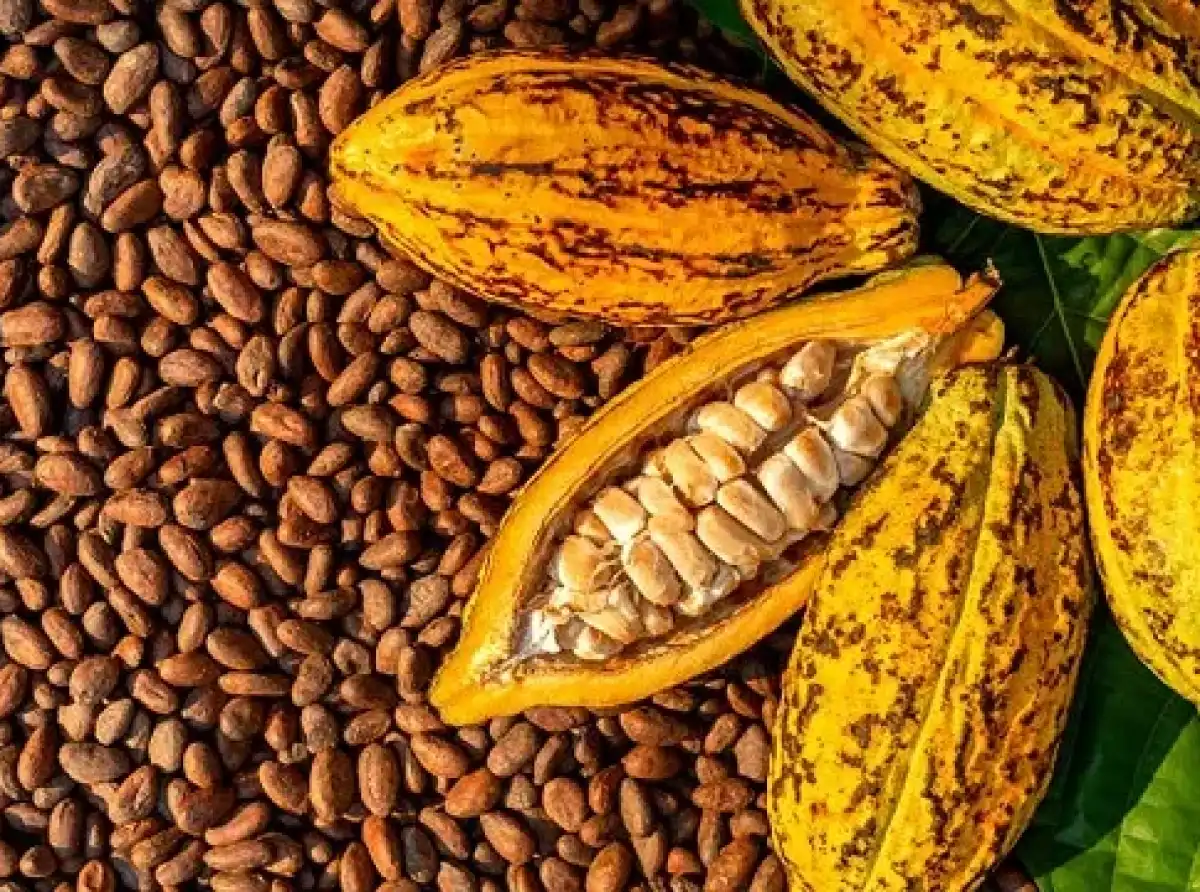
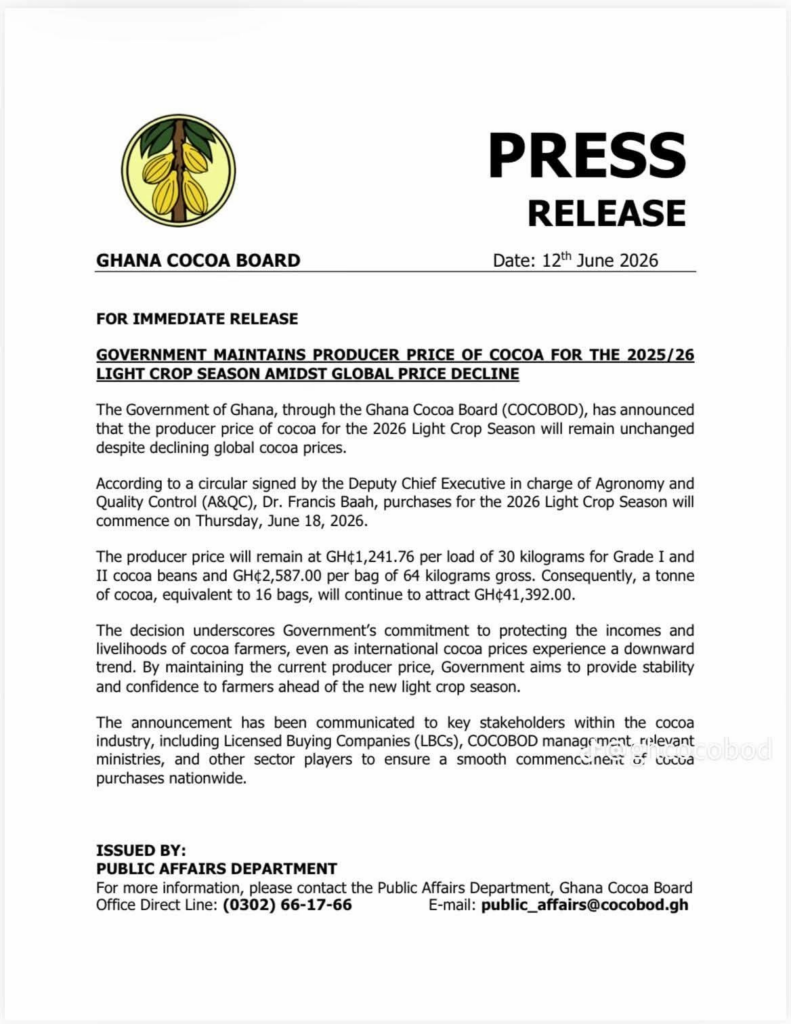
The Government of Ghana, through the Ghana Cocoa Board, has announced that the producer price of cocoa will remain unchanged for the 2026 Light Crop Season, despite a downturn in international cocoa prices.
The decision is intended to protect cocoa farmers from global market volatility and ensure stability within one of Ghana’s most important economic sectors.
According to a circular issued on Friday, June 12, 2026, and signed by Dr. Francis Baah, cocoa purchases for the 2026 Light Crop Season will officially commence on June 18, 2026.
Under the new directive, cocoa farmers will continue to receive:
- GH¢1,241.76 per load (30 kilogrammes) of Grade I and II cocoa beans.
- GH¢2,587.00 per 64-kilogramme bag.
- GH¢41,392.00 per metric tonne, equivalent to 16 bags of cocoa.
The maintained pricing structure comes at a time when international cocoa prices have experienced fluctuations, creating uncertainty across global cocoa-producing markets.
COCOBOD explained that maintaining the current producer price demonstrates the government's commitment to safeguarding farmers' incomes and sustaining confidence in the cocoa sector.
The board noted that cocoa farmers remain the backbone of Ghana's cocoa industry and play a critical role in supporting national export earnings, rural employment, and economic growth.
“By sustaining the current pricing, we aim to provide stability and confidence to farmers ahead of the new light crop season,” the statement emphasized.
Ghana remains the world's second-largest cocoa producer and relies heavily on cocoa exports as a major source of foreign exchange earnings.
Industry analysts say the decision to maintain prices despite declining global rates could help:
- Cushion farmers against income losses.
- Discourage smuggling of cocoa beans across borders.
- Encourage continued investment in cocoa farms.
- Sustain production levels during the upcoming season.
The move is also expected to provide certainty for farmers as they prepare for harvesting activities during the light crop season.
COCOBOD has communicated the decision to all major stakeholders within the cocoa value chain, including:
- Licensed Buying Companies (LBCs)
- COCOBOD management
- Relevant government ministries
- Cocoa marketing agencies
- Farmer groups and industry participants
The board says the early notification is aimed at ensuring a smooth rollout of purchasing operations nationwide when the season opens on June 18.
While global cocoa prices have softened in recent months after reaching record highs, Ghana’s decision to maintain the producer price is expected to be welcomed by farmers facing rising production costs, including expenses related to fertilizers, labour, transportation, and farm maintenance.
The announcement reinforces government efforts to support cocoa production and protect rural livelihoods amid ongoing uncertainties in global commodity markets.

Aikines Anyomi

News
Food
Politics
Technology
About Us
Download Our Mobile App

