Mahama Touches Down In Angola For Crucial AU Summit On Conflict Resolution
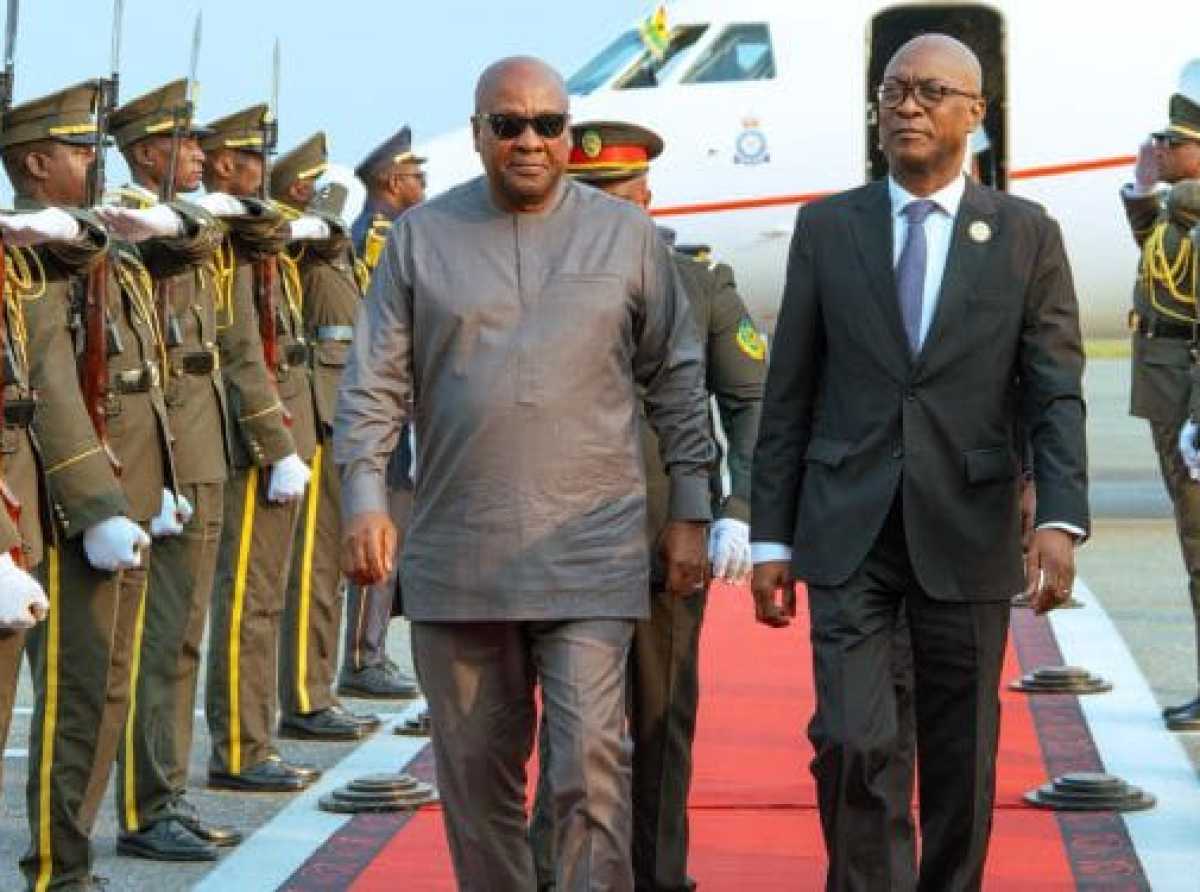
President John Dramani Mahama has arrived in Luanda, Angola, to participate in the 21st Extraordinary Session of the African Union (AU) Assembly of Heads of State and Government, which is focused on strengthening Africa’s capacity to prevent and resolve conflicts.
The high-level summit, scheduled for Sunday, August 30, brings together African heads of state and government to deliberate on pressing peace and security challenges confronting the continent.
The leaders are expected to consider and adopt a comprehensive Decision, Action Plan and Implementation Matrix aimed at improving Africa’s conflict prevention, management and resolution mechanisms.
A major focus of the summit will be an assessment of the effectiveness of two key continental frameworks—the African Peace and Security Architecture (APSA) and the African Governance Architecture (AGA).
Discussions are expected to examine how effectively these mechanisms are being coordinated and implemented, as well as their responsiveness to emerging threats and the availability of sustainable financing to support their operations.
President Mahama’s participation comes at a critical time for Africa, with several parts of the continent facing prolonged and complex security challenges.
Sudan continues to experience a devastating conflict, while instability in the eastern Democratic Republic of Congo remains a major concern for regional peace and security. The Sahel and parts of the Horn of Africa are also dealing with persistent insecurity, while an insurgency continues to affect northern Mozambique.
The convergence of these crises has heightened calls for stronger African-led approaches to conflict prevention, mediation, peacebuilding and post-conflict reconstruction.
The summit is being spearheaded by Angolan President João Manuel Gonçalves Lourenço, who serves as the African Union Champion for Peace and Reconciliation in Africa.
The gathering is therefore expected to provide an opportunity for African leaders to strengthen political commitment towards addressing the root causes of conflicts while improving the continent’s ability to respond collectively to emerging security threats.
President Mahama and other participating leaders are expected to work towards consensus on practical measures to reinforce Africa’s peacebuilding efforts and strengthen the effectiveness of existing continental peace and security institutions.
The outcomes of the summit could have significant implications for Africa’s future conflict-prevention strategy, particularly as the continent seeks greater ownership of its peace and security agenda and more sustainable mechanisms for financing African-led interventions.

Aikines Anyomi

News
Food
Politics
Technology
About Us
Download Our Mobile App

