
Minority: 9% public sector salary increase 'is nothing short of an insult' to workers

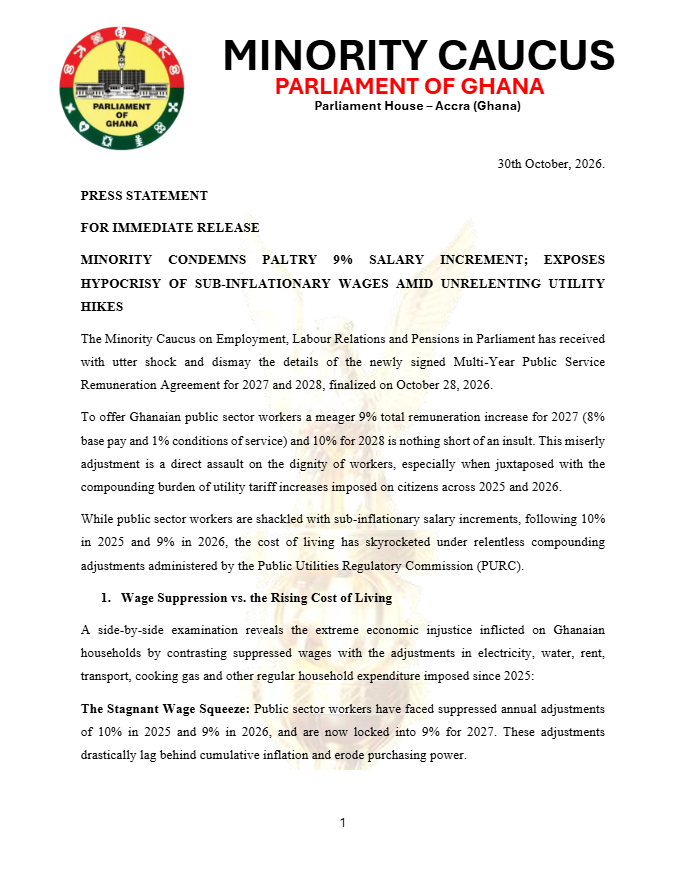
The Minority Caucus on Employment, Labour Relations and Pensions in Parliament has strongly criticised the newly signed public sector remuneration agreement, describing the proposed 9% total salary increase for 2027 as an “insult” to Ghanaian public sector workers.
In a statement issued on October 30, 2026, and signed by the Ranking Member of the Committee on Employment, Labour Relations and Pensions, Mavis Nkansah Boadu, the Minority said it received the details of the Multi-Year Public Service Remuneration Agreement for 2027 and 2028 with “shock and dismay”.
Under the agreement, public sector workers are expected to receive a total remuneration increase of 9% in 2027. This comprises an 8% adjustment in base pay and an additional 1% adjustment in conditions of service.
The total increase is scheduled to rise to 10% in 2028.
However, the Minority argues that the agreed adjustments are inadequate and fail to reflect the financial pressures facing workers, particularly the rising cost of living and increases in utility tariffs.
The caucus cited electricity and other utility tariff increases introduced in 2025 and 2026 by the Public Utilities Regulatory Commission (PURC), arguing that the additional costs have placed further pressure on household budgets.
It maintained that the 2027 remuneration adjustment would offer insufficient relief to workers struggling to meet their daily expenses.
The Minority's criticism centres on the gap between the proposed pay increase and the cost pressures workers continue to face, particularly in relation to essential services.
The caucus also expressed solidarity with organised labour and public sector employees, rejecting the 9% increase as inadequate.
“The Minority Caucus stands in absolute solidarity with the rank and file of Organised Labour and the suffering workers of Ghana. We reject this insulting 9% pay deal in the face of relentless electricity tariff hikes,” the statement concluded.
The criticism adds to the debate surrounding public sector remuneration and the balance between workers' demands for improved earnings and the government's compensation arrangements for the 2027 and 2028 financial years.

Aikines Anyomi

News
Food
Politics
Technology
About Us
Download Our Mobile App

