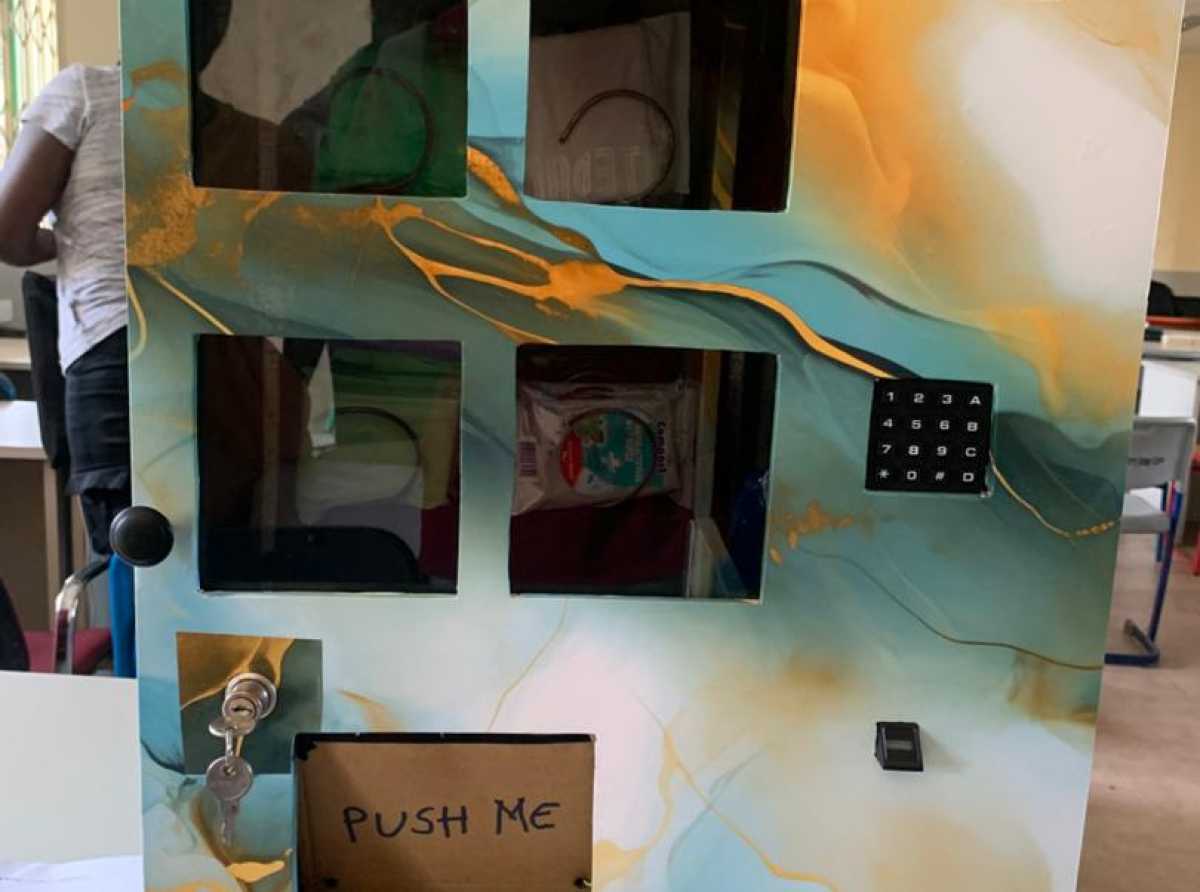
A team of students at the University of Mines and Technology (UMaT) in Tarkwa has developed an innovative Smart Sanitary Pad Vending Machine (SSPVM), a technology-driven solution designed to improve menstrual hygiene management and support uninterrupted academic participation among female students.
The groundbreaking innovation was highlighted during the recent launch of the Robotech Lab project at UMaT, where the Minister for Communication, Digital Technology and Innovations and Member of Parliament for Ningo-Prampram, Samuel Nartey George, underscored the importance of investing in homegrown technological solutions.
“The next generation of Ghana’s engineers would not be imported but created,” he stated, emphasizing the need for Ghana to position itself as a producer of innovation rather than merely a consumer of technologies developed elsewhere.
His remarks come at a time when Ghana is increasingly seeking to harness science, technology and innovation to address pressing national challenges in sectors such as healthcare, education, agriculture, energy and mining. The development of the Smart Sanitary Pad Vending Machine is being viewed as one such innovation with the potential to make a meaningful social impact.
The project was developed by a team of students under the supervision of Dr. Emmanuel Effah, Head of the Applied Science, Computer Science and Engineering Department (ASCSES) at UMaT. The machine is designed to provide registered female students with immediate, free and dignified access to sanitary pads and hygiene wipes during emergencies without requiring assistance from staff or administrators.
The initiative aims to tackle one of the major barriers affecting girls’ education and wellbeing across many parts of Africa—limited access to menstrual hygiene products. Research across Sub-Saharan Africa has consistently shown that inadequate access to sanitary products contributes to absenteeism, reduced participation in class and interruptions in academic progress.
In Ghana, the challenge remains significant. A 2024 report by SEND Ghana revealed that 63 percent of basic schools lack adequate Water, Sanitation and Hygiene (WASH) facilities, highlighting broader concerns surrounding menstrual health management and access to hygiene resources.
The SSPVM complements ongoing national efforts to address these issues. In April 2025, the Government of Ghana launched the National Sanitary Pad Distribution Programme with an allocation of GH¢292.4 million aimed at providing free sanitary pads to female students in primary and secondary schools.
While the government's initiative focuses on pre-tertiary institutions, the SSPVM addresses a gap that remains largely unaddressed at the tertiary level, offering university students a reliable and technology-enabled means of accessing menstrual hygiene products when needed.
The machine combines embedded systems engineering and Internet of Things (IoT) technology to create a secure, scalable and cost-effective dispensing platform. At its core is an ESP32 microcontroller, selected for its dual-core processing capability, built-in Wi-Fi and Bluetooth functionality, and suitability for continuous operation.
To ensure secure access, the system incorporates a biometric fingerprint scanner alongside a physical keypad, creating a dual-layer authentication process. This allows only registered users to access products while maintaining privacy and accountability.
Importantly, the system has been designed to protect users' personal information. Usage records are not linked to identifiable personal data beyond monitoring allocation limits, ensuring confidentiality for students.
The machine also features an LCD display that provides users with real-time feedback throughout the dispensing process, making the system easy to use and accessible.
To ensure equitable distribution, the SSPVM employs a quota management system. Each authenticated student can receive a maximum of two sanitary pad units per dispensing session and no more than five units within a calendar month. The approach is intended to prevent abuse while ensuring that products remain available to a larger number of beneficiaries, particularly during periods of high demand such as examination seasons.
One of the key strengths of the innovation is its IoT-enabled monitoring capability. The system allows administrators to remotely track inventory levels, receive low-stock notifications and detect potential tampering. These features support efficient inventory management and data-driven procurement planning while reducing operational costs.
The machine operates under a university-subsidised model, meaning students can access products free of charge. To further promote privacy and convenience, the vending units are designed for discreet installation in female washrooms and student welfare corridors across campus.
Beyond its immediate practical benefits, the SSPVM aligns closely with several United Nations Sustainable Development Goals (SDGs). It supports SDG 3 by promoting health and wellbeing through improved access to menstrual hygiene products. It contributes to SDG 4 by helping eliminate barriers that can disrupt educational attainment among female students. The project also advances SDG 5 by promoting gender equality and ensuring that female students can pursue their education without avoidable interruptions related to menstrual health.
At the national level, the innovation complements Ghana’s evolving menstrual health policies and strengthens efforts to improve WASH standards across educational institutions. It also offers a replicable model that could be deployed across universities and colleges nationwide, helping bridge gaps in menstrual product accessibility at the tertiary level.
The Smart Sanitary Pad Vending Machine represents a practical example of how collaboration between academia, technology and public policy can deliver innovative solutions to social challenges while advancing inclusive development and empowering young women through education.

Aikines Anyomi

News
Food
Politics
Technology
About Us
Download Our Mobile App

