
President Mahama puts mining firms on notice over 2030 raw mineral ore export ban
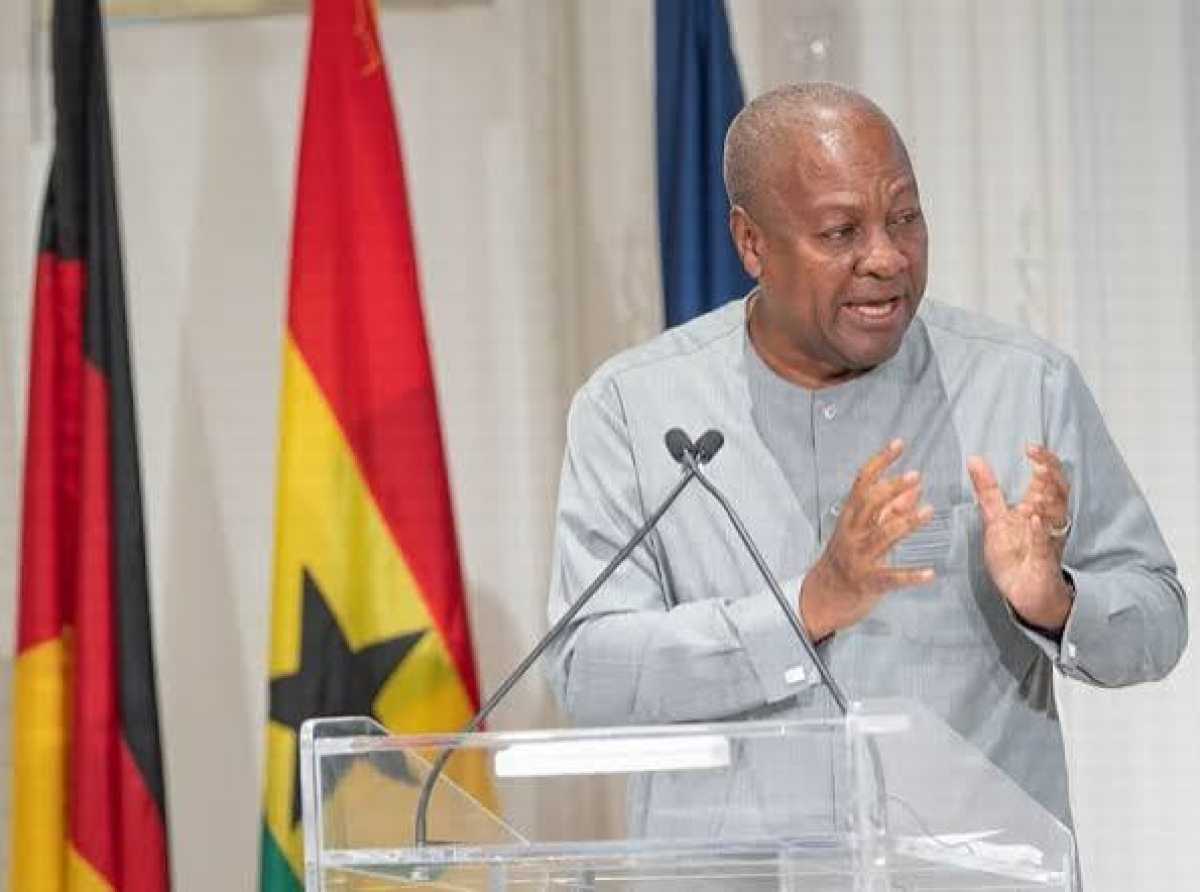
President John Dramani Mahama has reaffirmed Ghana’s plan to stop exporting raw mineral ores by 2030, urging mining companies to begin investing in local processing and value addition.
Speaking at the Council on Foreign Relations in New York on September 25, President Mahama said mining companies must prepare for a policy shift that would require minerals extracted in Ghana to undergo at least primary and secondary processing before leaving the country.
“I have said that by 2030 we're not going to export any raw ores, mineral ores, out of Ghana,” President Mahama said.
“So those who are mining today must be mindful that they begin to put in at least primary and secondary processing of the ores,” he added.
Ghana produces gold, bauxite, manganese and diamonds and is also developing its lithium industry.
The President first announced the 2030 deadline in February 2026, when he said Ghana would no longer allow raw manganese, bauxite and iron ore to be exported without local processing. The policy forms part of his Accra Reset initiative, which seeks to increase value addition and retain a greater share of the economic benefits generated from Africa’s natural resources.
His latest comments came a day after he told the 81st United Nations General Assembly that Africa must process its critical minerals locally rather than continue exporting raw resources and importing higher-value finished products.
While the broader 2030 raw-mineral export target has not yet been fully established in legislation, the government has already introduced measures to increase domestic processing of gold.
Effective July 1, 2026, large-scale mining companies are required under an agreement with the Ghana Gold Board (GoldBod) to sell 30% of their gold output to GoldBod in doré form at a 0.55% discount.
GoldBod said the gold would be refined locally as part of efforts to retain more value in Ghana and support the country's goal of securing London Bullion Market Association accreditation for at least one local refinery by 2030.
GoldBod has also introduced mandatory local refining requirements for gold doré exported by self-financing aggregators.
Under a directive that took effect on September 1, 2026, no unrefined gold doré is to be approved for export. GoldBod said exporters must first have the gold refined at an approved Ghanaian refinery before export applications can be processed.
The measures indicate that the government's value-addition policy is already being applied more directly to the gold sector, although the treatment of other minerals such as manganese and bauxite remains an important part of the broader 2030 agenda.
The proposed Minerals and Mining Bill, laid before Parliament in May 2026, is expected to provide a framework through which the government could impose restrictions on the export of unprocessed or raw mineral concentrates.
However, the legislation itself does not establish a specific 2030 deadline for ending raw mineral exports. The proposed framework would allow the Minister responsible for mining to prohibit the export of unprocessed or raw mineral concentrates and require local processing through regulations.
This means the President's 2030 target remains a stated government policy objective while the legal and regulatory mechanisms required to implement the broader ban continue to develop.
President Mahama has argued that Ghana must move beyond exporting natural resources in their least-processed form if the country is to create more jobs, industrial capacity and economic value from its mineral wealth.
The approach is particularly significant for minerals such as manganese and bauxite, which are largely exported in ore form and therefore have greater potential for additional domestic processing.
The government has also sought to strengthen local participation in the mining industry through changes to royalty arrangements, mineral-sector governance and the management of mining leases.
In February, President Mahama said Ghana would support the establishment of refineries and other infrastructure needed to process minerals locally, including bauxite, manganese and lithium.
Lithium is emerging as a new component of Ghana's minerals strategy, following the ratification of the mining lease for Atlantic Lithium's Ewoyaa project in the Central Region.
The project is designed to produce spodumene concentrate, a partially processed form of lithium, making questions around further local value addition increasingly relevant as Ghana develops its lithium industry.
The government's broader objective is to ensure that the country's mineral resources contribute more directly to domestic industrialisation rather than primarily generating export earnings through the shipment of raw or minimally processed materials.
President Mahama's latest remarks therefore place mining companies on notice that the government expects greater investment in domestic processing ahead of the 2030 target.
The deadline, however, extends beyond the end of President Mahama's current term in January 2029, meaning the implementation and enforcement of the policy will ultimately depend on subsequent governments and the legal framework established before then.

Aikines Anyomi

News
Food
Politics
Technology
About Us
Download Our Mobile App

