
Health experts are calling for urgent national action to tackle Obstetric fistula in Ghana, revealing that more than 7,000 women are currently living with the condition across the country.

Health experts are calling for urgent national action to tackle Obstetric fistula in Ghana, revealing that more than 7,000 women are currently living with the condition across the country.
The Food and Drugs Authority (FDA) has intensified regulatory inspections and monitoring of imported frozen chicken, meat, and fish following growing national concerns over food safety standards, including the recent ban on “chofi” in parts of the country.

A medical doctor has filed a major lawsuit against three of Ghana’s leading public hospitals, several healthcare professionals, and the Attorney General, alleging that a chain of negligent actions and refusal of emergency treatment led to the tragic death of her younger brother following a road accident in February 2026.

The Ministry of Health has defended its recent recruitment exercise involving thousands of health professionals, stating that the process was carefully designed to support the government’s free primary healthcare policy and improve healthcare delivery in rural and underserved communities across the country.

President John Dramani Mahama has strongly criticised the previous Akufo-Addo administration over the implementation of the Agenda 111 hospital initiative, describing the decision to begin construction of all 111 hospitals simultaneously as financially imprudent and poorly planned.
.jpeg)
The Ministry of Health has assured Ghanaians that no suspected or confirmed case of Ebola Virus Disease (EVD) has been detected in the country despite recent outbreaks reported in Uganda and the Democratic Republic of the Congo (DRC).
.jpg)
Allied Health Professionals at the Korle Bu Teaching Hospital staged a peaceful protest on Friday, calling for the immediate establishment of a dedicated directorate for their department at the hospital’s Central Laboratory.

The Minister for Health, Kwabena Mintah Akandoh, has dismissed allegations that the Ministry of Health’s recruitment portal is fraudulent, explaining that the challenges applicants are experiencing are due to extremely high traffic and system congestion rather than any form of scam.

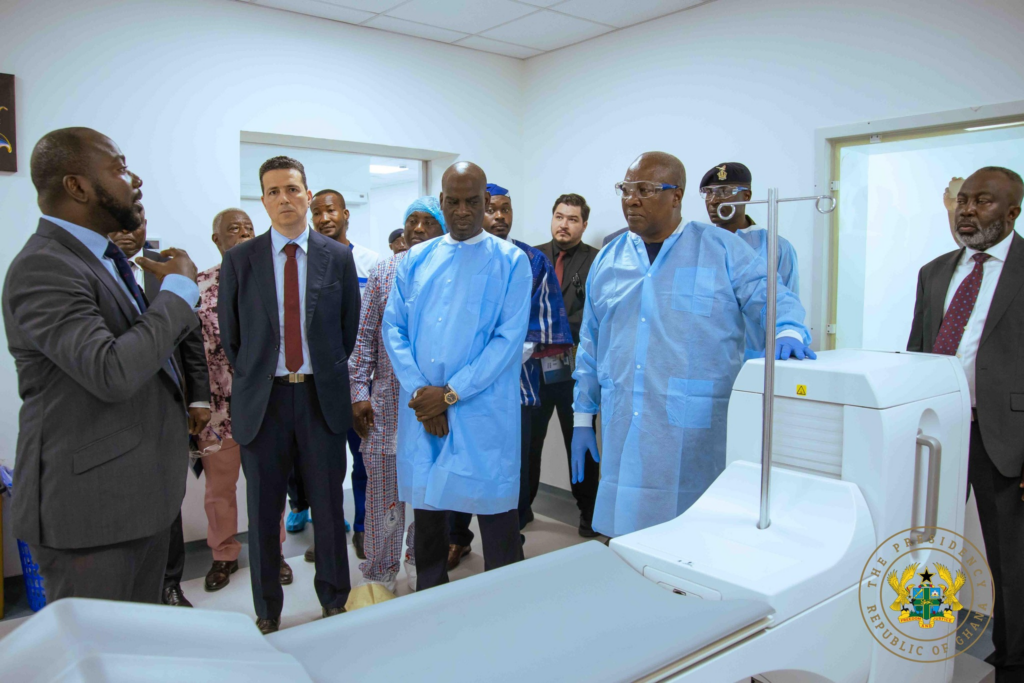
President John Dramani Mahama has commissioned a new Positron Emission Tomography (PET) scan facility at the Swedish Ghana Medical Centre in Accra, describing the development as a significant step toward achieving world-class healthcare delivery and strengthening Ghana’s medical independence.
The modern diagnostic facility is expected to significantly improve early detection of cancer and other critical diseases, enhance treatment outcomes, and reduce the number of patients who travel abroad for advanced medical imaging services. Health experts say PET scan technology plays a vital role in identifying cancer stages accurately, thereby improving the effectiveness of treatment plans.
President Mahama noted that the establishment of the facility also positions Ghana as an emerging medical hub within the West African sub-region, capable of offering advanced diagnostic services to neighbouring countries.
He commended the management of the Swedish Ghana Medical Centre and the Ghana National Association of Teachers (GNAT) for what he described as a visionary partnership and investment in national development.
The President emphasized that strengthening healthcare infrastructure remains a central priority of his administration, particularly in the areas of cancer diagnosis, specialist care and medical accessibility.
Beyond the commissioning of the PET scan facility, President Mahama also outlined a series of planned interventions aimed at improving key sectors of the economy, including healthcare, education and housing.
Among the announced initiatives are the construction of new regional hospitals across the country, the establishment of additional CAT scan laboratories, and expanded teacher accommodation projects designed to improve welfare and working conditions for educators.

He also highlighted the $300 million STARR-J initiative, which is expected to support efforts to eliminate Ghana’s double-track system in senior high schools by 2027, a reform aimed at improving access, academic consistency and overall quality of secondary education.
According to the President, these interventions form part of a broader national development agenda that prioritizes human capital development through improved healthcare delivery, enhanced educational infrastructure and better living conditions for public sector workers.
Education stakeholders have long called for sustained investment in infrastructure and teaching resources to address overcrowding and operational challenges within the double-track system, which was introduced to accommodate increased student enrollment.
President Mahama reiterated that quality healthcare, teacher welfare and education remain key pillars of Ghana’s long-term development strategy, adding that progress in these sectors is essential for building a healthier, more educated and productive population.
He expressed optimism that ongoing investments in medical technology and education reforms will significantly improve national development outcomes and reduce inequality in access to essential public services.
The inauguration of the PET scan facility marks another milestone in Ghana’s healthcare modernization drive, with expectations that similar investments will continue to expand access to advanced medical services across the country.


The Administrator of the Ghana Medical Trust Fund, popularly known as MahamaCares, Mrs. Adjoa Obuobia Darko-Opoku, has clarified that the initiative is designed to complement the National Health Insurance Scheme (NHIS) rather than replace it.
.jpg)
The National Health Insurance Authority (NHIA) has announced the immediate suspension of three pharmacies from participating in the National Health Insurance Scheme (NHIS) over allegations of suspected fraudulent claims and irregular service transactions.
.jpg)
The head of the World Health Organization has said there is currently “no sign” of a wider hantavirus outbreak following the evacuation of passengers from the cruise ship MV Hondius, which has been linked to multiple confirmed infections and several deaths.
WHO Director-General Tedros Adhanom Ghebreyesus made the remarks during a press briefing in Madrid, while cautioning that the situation remains under close observation due to the virus’s long incubation period.
“At the moment, there is no sign that we are seeing the start of a larger outbreak,” he said. “But of course the situation could change and, given the long incubation period of the virus, it’s possible we might see more cases in the coming weeks.”
The outbreak is connected to the Dutch-flagged expedition vessel MV Hondius, which has been under health monitoring after passengers developed symptoms consistent with hantavirus infection during a voyage that began in Ushuaia, Argentina on April 1.
So far, seven cases have been confirmed among passengers and crew, including individuals who tested positive after returning to their home countries. Three deaths have also been recorded in connection with the outbreak, including an elderly Dutch passenger, his wife, and a German woman who died onboard the vessel.
Health authorities believe the strain involved may be the Andes variant of hantavirus, which is known to be carried by rodents and can, in rare cases, spread between humans.
The final group of 28 passengers was evacuated from the ship and flown to Eindhoven Airport on Tuesday after earlier repatriation flights brought other passengers home. The vessel is now sailing toward Rotterdam, where it is expected to arrive around May 17.
According to the ship operator Oceanwide Expeditions, 122 passengers and crew have now been repatriated through government-arranged flights.
Only 27 people remain on board, including 25 crew members and two medical staff, while some individuals from countries such as the Philippines, Ukraine, the Netherlands, Russia, and Poland are assisting with the ship’s transfer operations.
Authorities in the Netherlands have also placed 12 hospital workers in quarantine after possible exposure while treating an evacuated patient. The hospital in Nijmegen said the measure was precautionary after some staff did not fully follow strict safety protocols when handling blood and urine samples.
Health officials have stressed that human-to-human transmission of hantavirus remains rare, although it is possible with certain strains.
Hantavirus infections can cause severe illness, with symptoms including fever, extreme fatigue, muscle pain, vomiting, abdominal pain, diarrhea, and in severe cases, breathing difficulties.
Despite the cluster of cases linked to the cruise ship, WHO officials have reiterated that the overall risk of a major outbreak remains very low.
Several countries, including France, Spain, the United States, the United Kingdom, and South Africa, are currently monitoring or treating repatriated passengers who tested positive or showed symptoms after disembarkation.
Contact tracing is ongoing, particularly in France, where health authorities are monitoring more than 20 contacts linked to one confirmed case.

The Administrator of the Ghana Medical Trust Fund, Obuobia Darko-Opoku, has announced that the government’s Nationwide Patient Support Programme will officially begin full implementation in June 2026, following a successful pilot phase earlier this year.