
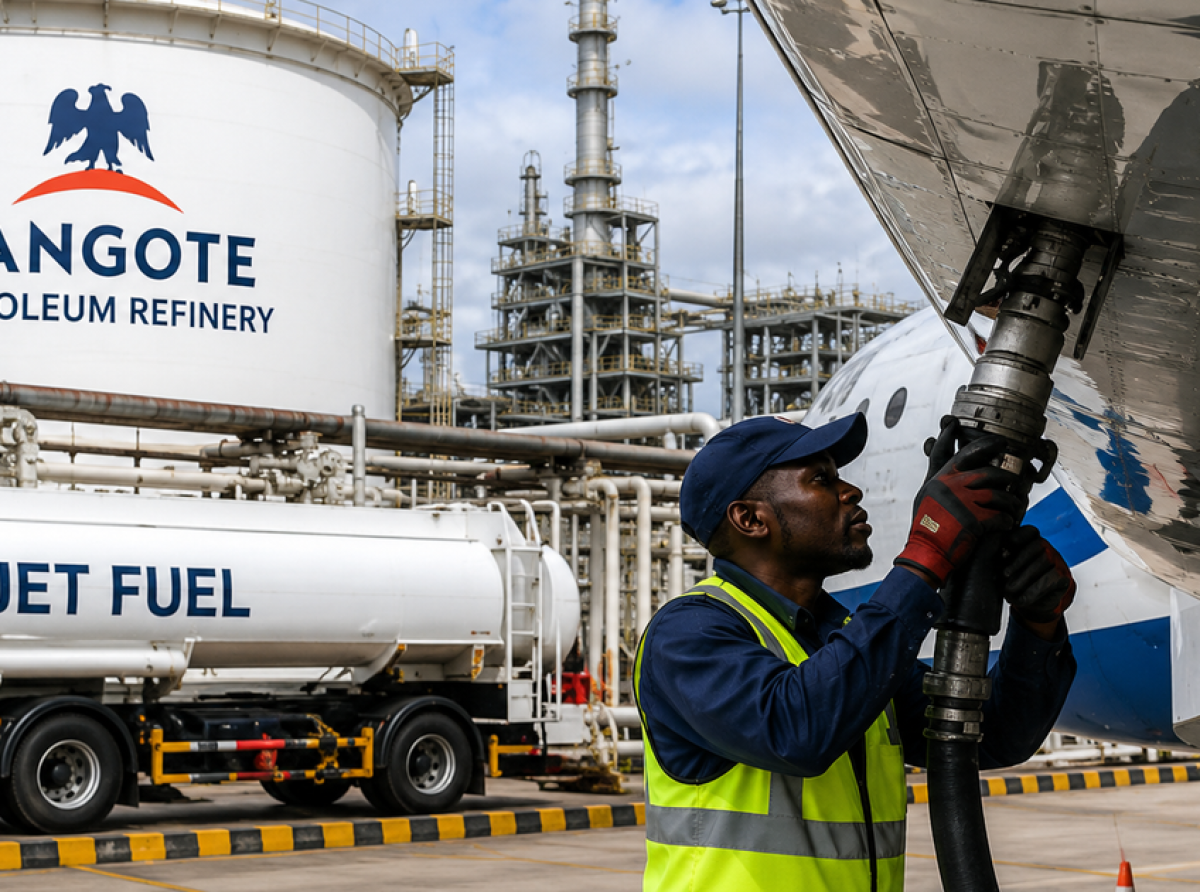
Nigeria’s massive Dangote Refinery has announced that it has a significant surplus of jet fuel available for export and is positioning itself as a major supplier to international markets amid growing global demand.
Speaking at the S&P Global Energy Middle East Petroleum and Gas Conference in London, Chief Executive David Bird revealed that the refinery's production capacity currently exceeds jet fuel demand across Africa, creating opportunities to supply airlines and fuel distributors worldwide.
"We're very grateful to be seen as a reliable, high-quality and dependable supplier able to land our product competitively all over the world," Bird said.
The 650,000-barrel-per-day refinery, widely regarded as Africa's largest single-train refinery, is currently operating at its full nameplate capacity, according to Bird.
The facility has rapidly emerged as a major player in global fuel markets since commencing operations, helping to transform Nigeria from a country heavily dependent on imported refined petroleum products into a significant refining hub.
Bird noted that recent disruptions in global energy markets have increased demand for jet fuel from suppliers located outside the Gulf region.
Jet fuel has been among the petroleum products most affected by geopolitical tensions and disruptions linked to the conflict involving Iran and shipping challenges through the Strait of Hormuz, creating new opportunities for alternative suppliers.
As a result, Dangote Refinery is leveraging its strategic location and refining capacity to expand exports into international markets.
Beyond its current operations, the company has unveiled ambitious plans to significantly increase its refining footprint over the next few years.
Bird disclosed that Dangote is pursuing what he described as a "ruthless replication" strategy aimed at doubling the refinery's processing capacity.
Under the expansion programme, an additional 700,000 barrels per day of sophisticated refining capacity is expected to come on stream by the end of 2028.
"We will bring 700,000 barrels per day of fully complex refining capacity on stream by the end of 2028," he stated.
According to Bird, the company has already secured key long-lead equipment and is currently awarding construction contracts for the project.
The expansion forms part of a broader strategy to establish Dangote as one of the world's most influential refining and energy companies.
Bird indicated that the group ultimately aims to increase total refining capacity to approximately 2.1 million barrels per day through additional investments, including plans for another refinery in East Africa.
If completed, the projects would significantly increase Africa's refining capacity and strengthen the continent's role in global crude oil and refined petroleum product markets.
The Dangote executive also highlighted the refinery's impact on Nigeria's domestic fuel market.
According to him, the country has moved from chronic fuel shortages to a position of fuel abundance since the refinery became operational.
The development has reduced dependence on imported fuels, strengthened domestic supply chains and enhanced energy security in Africa's largest economy.
As the refinery continues to expand production and export volumes, industry analysts expect it to play an increasingly important role in shaping fuel trade flows across Africa and international markets.

Aikines Anyomi

News
Food
Politics
Technology
About Us
Download Our Mobile App

