Legal luminary Tsatsu Tsikata says he believes the darkest days of judicial manipulation in Ghana are fading. His remarks come at a time when public discourse around judicial independence and accountability continues to shape national conversations on governance and the rule of law.
The New Patriotic Party (NPP) is set to stage a protest today, Wednesday, April 22, in Sunyani, a move expected to heighten political tensions in the Bono Region. The planned demonstration comes at a time of increasing political activity in the area, with observers closely monitoring developments for their potential national implications.
A coalition of 12 civil society organisations (CSOs) has announced plans to apply to the Supreme Court of Ghana to participate as amicus curiae in a case concerning the Office of the Special Prosecutor (OSP).
The government of Ghana has approved new visa waiver agreements with Antigua and Barbuda, the Maldives and Zambia as part of efforts to expand travel opportunities and strengthen diplomatic relations, Foreign Affairs Minister Samuel Okudzeto Ablakwa has announced.
Former Chairman of Parliament’s Public Accounts Committee (PAC), James Klutse Avedzi, has urged caution in the interpretation of Auditor-General reports, stressing that such documents should not be treated as infallible without thorough verification and parliamentary scrutiny.
His comments come in response to growing public debate over the credibility of audit findings, particularly following recent corrections—such as the widely discussed case involving Frank Kpodo—which highlighted errors in previously published figures.
Mr Avedzi noted that while reports produced by the Auditor-General’s Department are authoritative and form a critical part of public financial oversight, they are ultimately compiled by individuals and are therefore not immune to mistakes.
“The Auditor-General is a human being and can make mistakes. It is always better to cross-check and verify again,” he stated.
He explained that under Ghana’s constitutional framework, Auditor-General reports are formally submitted to Parliament, where they undergo detailed examination—primarily by the Public Accounts Committee—before any conclusions are reached or actions recommended.
According to him, this parliamentary review process serves as an essential safeguard, allowing lawmakers to interrogate findings, identify inconsistencies, and ensure that any errors are corrected before the information is relied upon by the public.
Mr Avedzi cautioned that premature interpretation and publication of audit findings—especially by media organisations or individuals—can lead to misrepresentation and unintended reputational damage to those named in such reports.
“These reports are meant to be properly reviewed by Parliament and its committees. It is not for individual media houses or opinions to conclude on them before that process is complete,” he emphasised.
He added that adhering to the proper parliamentary process not only ensures accuracy but also protects the integrity of key state institutions, including the Auditor-General’s office.
By allowing Parliament to complete its scrutiny role, discrepancies can be addressed in a structured and transparent manner, strengthening public confidence in both the audit process and governance systems.
“In that way, the integrity of the Auditor-General is also protected,” he concluded.
His remarks contribute to the broader national conversation on accountability, transparency, and the responsible use of public financial data, particularly at a time when audit reports continue to attract significant public and media attention.
The Public Accounts Committee (PAC) has directed the Sunyani West Municipal Assembly to immediately refund GH₵116,000 after uncovering the unlawful disbursement of public funds as end-of-service benefits (ESB).
The Member of Parliament for Anlo, Richard Kwame Sefe, has expressed concern over the slow progress of a $150 million coastal protection project funded by the World Bank, warning that a significant portion of the funds may be consumed by administrative expenses before any physical work begins.
The Court of Appeal Ghana has dismissed a renewed application filed by the New Patriotic Party (NPP) Ashanti Regional Chairman, Bernard Antwi-Boasiako, seeking to halt his ongoing criminal trial in the alleged Samreboi illegal mining case.
A retired officer of the Ghana Police Service in the Ashanti Region has reportedly been assaulted by operatives believed to be from National Security Secretariat Ghana in an incident that has triggered widespread public outrage after a disturbing video surfaced online.
The Member of Parliament for Gushegu and Ranking Member on Parliament’s Legal Affairs Committee, Hassan Tampuli, has alleged that recent legal and political actions targeting the Office of the Special Prosecutor (OSP) are part of a deliberate and coordinated effort to weaken the institution following its pursuit of high-profile corruption cases.
Flagbearer of the New Patriotic Party (NPP), Mahamudu Bawumia, has raised concerns about the state of Ghana’s democracy, alleging that key democratic principles—particularly freedom of expression—are under increasing threat.
The Minister for Local Government, Chieftaincy and Religious Affairs, Ahmed Ibrahim, has issued a firm warning to contractors engaged in the government’s 24-Hour Economy Model Market programme, cautioning that poor workmanship, project delays, and failure to adhere to specifications will not be tolerated.
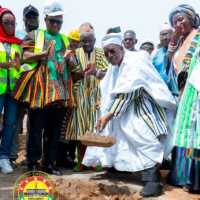
The Minister delivered this warning as construction officially commenced on new 24-Hour Economy Model Markets in Bimbilla and Kukuo. These projects form part of the government’s broader Resetting Ghana Tour and its decentralised infrastructure development agenda aimed at boosting economic activity at the local level.
Ahmed Ibrahim stressed that the market projects are critical national investments designed to strengthen local economies, improve trading environments, and support small businesses. As such, he emphasised that contractors must strictly comply with quality standards, timelines, and cost requirements to ensure the long-term success and sustainability of the initiative.
He noted that the government is committed to delivering durable, high-quality infrastructure that can withstand the demands of continuous, round-the-clock economic activity. According to him, any compromise in quality or delivery would undermine the objectives of the programme and waste public resources.
The Minister further revealed that monitoring and evaluation systems across all Metropolitan, Municipal and District Assemblies (MMDAs) have been significantly strengthened to ensure closer supervision of ongoing projects. These enhanced oversight mechanisms are intended to enforce accountability and ensure that contractors meet their contractual obligations.
He warned that any contractor who fails to meet the agreed standards or timelines will face serious consequences, including possible termination of contracts and other sanctions.
The 24-Hour Economy Model Market programme is being rolled out across all 261 MMDAs nationwide, reflecting the government’s commitment to decentralised development. In the current phase, 16 assemblies within the Northern Region are benefiting from the initiative.
The programme is designed to promote continuous economic activity by providing modern market infrastructure that supports traders, farmers, and small-scale enterprises. It also aims to improve sanitation, enhance market organisation, and create safer and more efficient trading spaces.
The markets in Bimbilla and Kukuo are part of a wider strategy to strengthen rural-urban economic linkages, increase local productivity, and expand access to economic opportunities at the grassroots level. By improving infrastructure in underserved areas, the government hopes to stimulate inclusive growth and reduce regional disparities.
The initiative is also aligned with the Accounting to the People Interactive Forum on Local Governance and Decentralisation, a key component of the Resetting Ghana Tour that promotes transparency, citizen participation, and accountability in governance.
The sod-cutting ceremonies for the projects were attended by cabinet ministers, senior government officials, local authorities, traditional leaders, traders, youth groups, and community members, reflecting broad stakeholder support for the initiative.
Many stakeholders have welcomed the programme, describing it as a transformative step toward improving livelihoods, enhancing local commerce, and creating sustainable economic opportunities within districts.
The government has reiterated that strict supervision, quality assurance, and performance enforcement will remain central to the successful implementation of all infrastructure projects under the 24-hour economy programme, as it seeks to deliver long-term benefits to communities across the country.
The Controller and Accountant-General’s Department (CAGD) has firmly rejected claims circulating on social media that a senior civil servant at Ghana’s Defence Ministry received unearned salaries amounting to GH¢427 million over a 29-month period.