
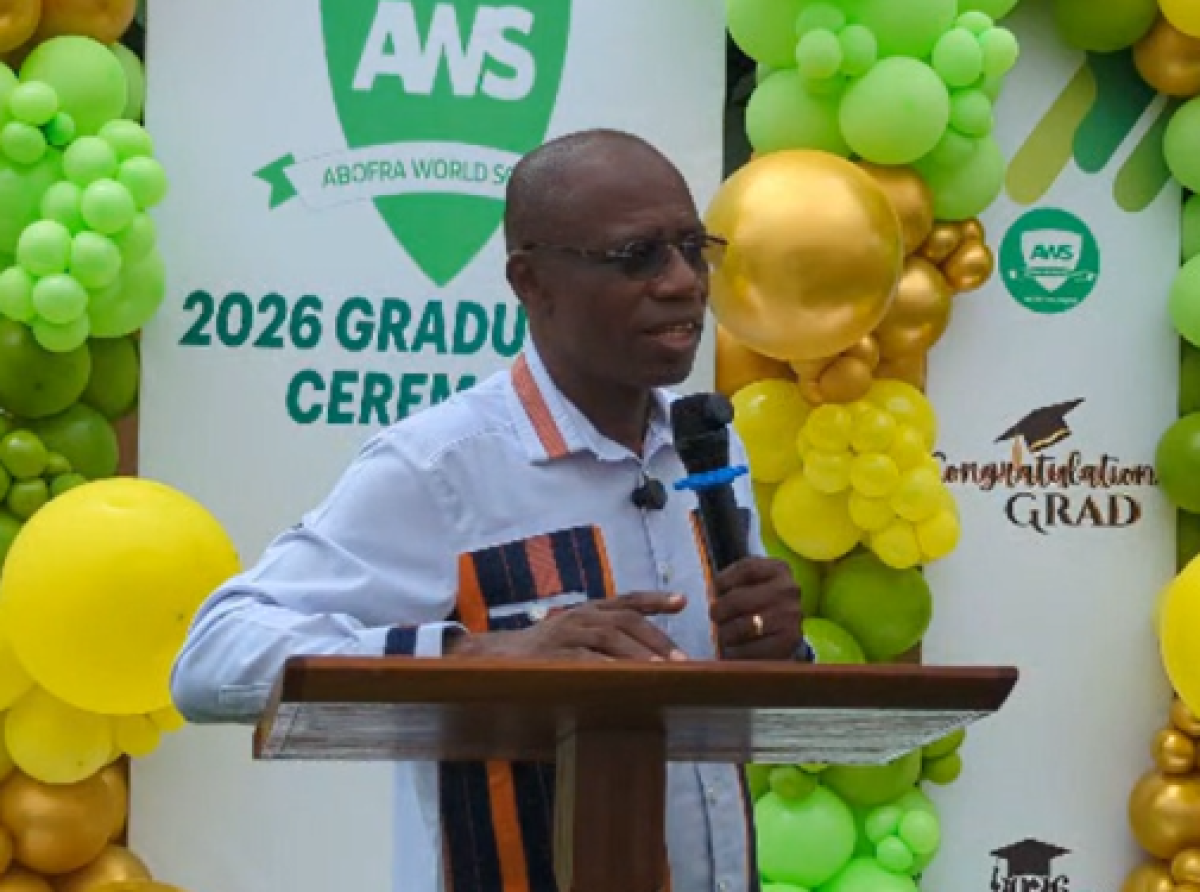
Former Director-General of the National Council for Curriculum and Assessment (NaCCA), Prof. Edward Appiah, has called for a fundamental overhaul of Ghana's education system, urging government and educational institutions to decolonise the national curriculum to better equip students for global competitiveness while preserving African identity and values.
According to the education expert, Ghana's curriculum continues to reflect colonial-era structures that were designed to produce clerks, catechists and administrators to serve colonial economies, rather than foster innovation, critical thinking and solutions tailored to African societies.
He argued that although African countries have attained political independence, many education systems have failed to undergo the transformation needed to meet contemporary development challenges.
Speaking at the graduation ceremony of Abofra World School in Kumasi, Prof. Appiah said meaningful educational reform must reconnect learning to local realities and encourage students to apply knowledge to solving challenges within their own communities.
He stressed that curriculum development should integrate disciplines, promote practical learning and strengthen the relationship between schools and society.
According to him, an education system rooted in local contexts while embracing global standards would better prepare learners to become innovators and responsible citizens.
Prof. Appiah challenged teachers, parents and policymakers to critically examine the purpose of education in Ghana.
Let me be emphatic in decolonising the African curriculum and I want to begin with a question, but I don't want the answer. A question that I want every teacher or parent to take a closer look at and reflect and review and probably you can give your answer later. Whose knowledge are we teaching or molding our children for?"
He cautioned that an education system focused solely on preparing students for opportunities abroad could unintentionally contribute to brain drain while weakening young people's connection to their communities.
If we are preparing our children for the curriculum that is for the global and they move along and they stay out, we are rather contributing more to brain drain, not just brain drain, but rather helping in dehumanising our own society because our children will not grow to empathise with our local community."
While acknowledging the importance of preparing students for a globalised world, Prof. Appiah argued that education must also cultivate a deep appreciation of African history, culture, values and indigenous knowledge systems.
He maintained that decolonising the curriculum does not mean rejecting international knowledge or standards but rather creating an education system that balances global excellence with local relevance.
According to him, Ghana's schools should produce graduates capable of competing internationally while remaining committed to addressing the country's social, economic and developmental challenges.
Prof. Appiah's remarks add to the growing national conversation on curriculum reform, with education stakeholders increasingly advocating for teaching approaches that promote innovation, entrepreneurship, critical thinking and community development alongside academic excellence.
His call underscores the need for an education system that not only prepares learners for international opportunities but also empowers them to contribute meaningfully to Ghana's long-term development.

Aikines Anyomi

News
Food
Politics
Technology
About Us
Download Our Mobile App

