
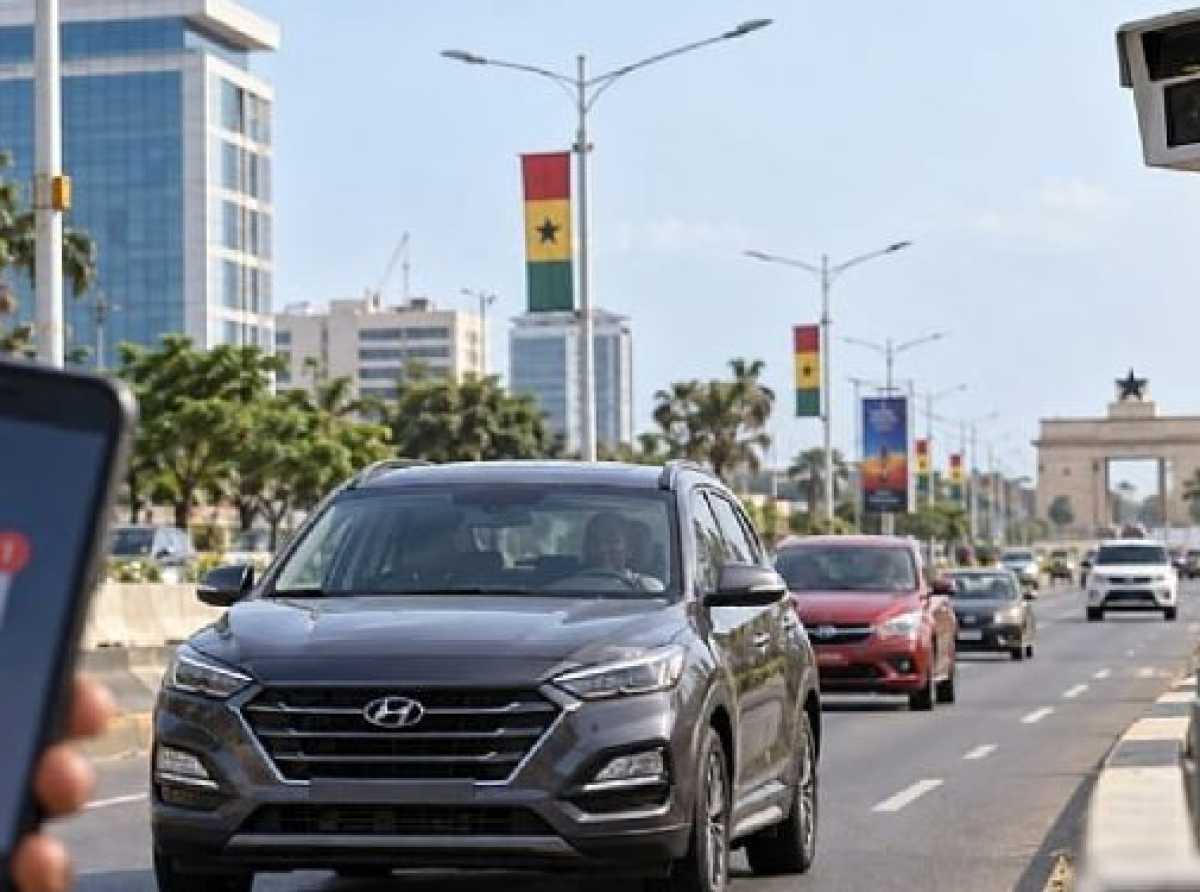
TraffiTech-GH went live on November 1, 2026. Almost immediately, five Ghanaian transport unions announced a nationwide strike for November 4, citing concerns about road infrastructure and enforcement. One line in their statement captured the central grievance: “We cannot operate in bus stops occupied by traders and still be fined by cameras.”
The rollout has revived questions about whether Ghana’s traffic enforcement system is ready for automated penalties—and whether the technology is being introduced to improve road safety or to generate revenue from a disorganised road environment.
When camera-based traffic enforcement was first proposed, I questioned whether the Police could transcend what I call katanomics: the tendency for seemingly sensible policies to produce absurd outcomes when implementation realities are ignored.
Where roads, signs, traffic lights and bus stops are poorly organised, automated enforcement risks treating every violation as straightforward. Manual policing has often relied on discretion to reconcile traffic rules with the disorder of the physical environment.
Now, the state has chosen a modern way to punish motorists for disorder rooted in an old infrastructure problem.
The objective—reducing road carnage—is easy to support. Road crashes killed 2,949 people in 2025, the highest annual toll in 35 years. But the question is not only what the system is meant to achieve. It is how it will work, whom it will affect, and whether its design is aligned with public safety.
The following concerns are documented here as a reference point for future evaluation—and as material for understanding katanomics.
The Motor Traffic and Transport Department (MTTD) has said TraffiTech-GH is currently limited to speeding, while other offences will continue to be enforced manually. This appears narrower than the Interior Minister’s August 2026 statement that the system covered more than 47 offences.
The scale of the problem being addressed remains unclear. There has been no recent comprehensive public assessment identifying which traffic offences cause the greatest harm and how much automated speeding enforcement can realistically reduce that harm.
Even for speeding, a basic question remains: What is the applicable speed limit on a particular stretch of road?
The Police FAQ lists four limits:
-
50 km/h in built-up areas;
-
90 km/h on highways;
-
100 km/h on motorways; and
-
30 km/h within school, playground, health facility, church, mosque, market, shopping centre or procession areas, or “anywhere human activity is predominant”.
In Accra or Kumasi, what exactly constitutes a zone where human activity is predominant? Where does it begin and end? Does a highway become a market zone when hawkers occupy the roadside? At what point can a driver safely return to the higher limit?
The state has deployed cameras capable of measuring speed precisely, yet motorists are left to interpret the geography of the offence.
The Police FAQ says signs will be placed at the start of enforced corridors and at selected points. It also says licensed drivers must know the limits whether or not signs are posted. At launch, however, motorists reported that signs were missing.
When drivers raise concerns about faulty traffic lights and missing signs, MTTD Director of Education, Research and Training ACP Alexander Kwaku Obeng has urged them not to “mix the issues up”. But these are not separate issues when enforcement depends on motorists clearly understanding the rules.
On launch day, ACP Obeng said some drivers had travelled at more than 130 km/h on Mahama Road, which he described as a 50 km/h road. He warned: “When the road is straight and flat in the city, don’t think it is a highway.”
That statement highlights the gap between what a road’s design may suggest to a driver and what the law requires. The conventional way to resolve that gap is clear, visible signage.
The Police intend to use mobile cameras placed in unmarked vehicles and on tripods. But there is a difference between concealing the enforcement officer and concealing the rule motorists are expected to obey.
CUTS International has pointed to provisions in L.I. 2519 requiring signage alongside speed cameras and called for speed limits to be posted before each camera location.
The argument that motorists should know every rule by heart is also questionable. Ghana’s revised Highway Code, launched in October 2023 to replace a version dating from 1974, predates the 2026 regulations and does not appear to address all the new enforcement arrangements.
Speed units create another complication. Many vehicles on Ghana’s roads are imported used cars, including vehicles from the United States whose speedometers display miles per hour. A driver travelling at 50 mph is moving at approximately 80 km/h. Yet some road signs display only a number, without specifying the unit.
These issues were foreseeable. In April 2018, the President’s road-safety plan promised GH¢335 million annually for three years for road signs and markings. Eight years later, automated fines have been introduced while the signage problem remains unresolved.
The penalty schedule is not consistently explained.
Regulation 242’s graduated schedule for automated offences reportedly begins at GH¢120 for each of the first three offences. But in October, ACP Obeng said speeding penalties begin at 20 penalty units—GH¢240—for every 5 km/h above the limit, with penalties increasing thereafter.
Other public explainers put speeding fines between GH¢240 and GH¢480.
Late-payment penalties are more clearly stated, though potentially severe. After 14 days, an additional 1 per cent of the fine is added for every day of default, with no published ceiling.
On that formula, a GH¢240 fine would double after 100 days and rise to GH¢1,116 after a year.
Meanwhile, the Roads Minister told Parliament in June that the government owed traffic-signal maintenance companies approximately GH¢40 million. The state has accumulated arrears for infrastructure needed to support road safety, while motorists are expected to pay fines promptly.
Ghana’s road deaths are not primarily a downtown Accra problem.
In 2025, Ashanti recorded 692 road deaths and Eastern 649, compared with 420 in Greater Accra, despite Greater Accra recording the highest number of crashes. The difference is in the severity of crashes: Eastern Region recorded 28 deaths for every 100 crashes, compared with 10 in Greater Accra.
Many fatal crashes occur on long intercity stretches, where high speeds, head-on collisions and poor visibility can be especially dangerous.
Even within the capital, the Accra Road Safety Report 2024 points to highways as major areas of concern. Of 118 deaths recorded in the Accra Metropolitan Area that year, 76 per cent occurred on highways within the city, including the N1.
The report identified locations such as the Kwashieman intersection and the Ring Road Central corridor. More deaths occurred between 8 p.m. and 10 p.m. than in any other two-hour period, and half occurred on weekends. Pedestrians, motorcyclists and cyclists accounted for 86 per cent of those killed.
Speeding in Accra is certainly a problem. Observational studies reportedly found that 44 to 49 per cent of vehicles exceeded speed limits on monitored roads in 2024.
The question is whether a few dozen mobile camera units, initially deployed in towns, are being positioned according to evidence about crash risk—or according to opportunities to issue large numbers of fines.
The Police should publish the deployment plan against crash data, including evening and weekend coverage. That would allow the public to distinguish genuine safety hotspots from locations that may simply be more profitable to enforce.
Pedestrians account for about a third of road deaths nationally. TraffiTech-GH cannot issue fines to pedestrians, and photographing a vehicle approaching a pedestrian does not make the road safer by itself.
What is needed includes usable pavements, refuge islands, raised crossings and safer road design.
Motorcycles are another major blind spot. The National Road Safety Authority reportedly recorded 226 motorbike-involved deaths among Greater Accra’s 420 road deaths in 2025—about 54 per cent.
During a July operation targeting racing on the George Walker Bush Highway near Villaggio, Police impounded 71 motorcycles, 26 of which were unregistered.
The DVLA has also said about 5 per cent of number plates in use are fake, often copied from wrecked vehicles. That raises a practical question: how will the system notify registered owners when registration records are inaccurate or do not exist?
A properly documented motorist may therefore be easier to fine than an unregistered or improperly documented road user who poses a serious danger.
Many deadly highway behaviours are also difficult to detect through automated speed readings. A speed camera cannot reliably assess an unsafe overtake on a blind bend, driver fatigue or the circumstances that caused a vehicle to swerve. These offences require evidence and judgement.
Red-light camera enforcement is reportedly planned for a later phase. But Ghana’s existing traffic-signal infrastructure remains unreliable.
An April 2026 Department of Urban Roads assessment found that only 257 of 411 traffic-signal installations were working. A 2025 National Safety Campaign survey reportedly found that only 13 per cent of traffic lights in Accra and surrounding cities were fully functional.
The Roads Minister has attributed some failures to the theft of signal components for scrap, while maintenance firms are reportedly owed about GH¢40 million.
CUTS International has also identified signals near the Apenkwa overpass and the Police Training Academy junction in Tesano that were positioned outside clear view, even where cameras appeared correctly placed.
The Accra Intelligent Traffic Management System was part of a US$210.6 million China Development Bank loan. In 2020, a US$100 million traffic contract was awarded to Huawei under the Ministry of National Security. The second phase has reportedly reached 23 per cent completion, held up by legal disputes and a US$55 million judgment debt.
Maintaining the infrastructure needed to make traffic rules work appears difficult. Yet the state has found private investors willing to make money by charging people for breaking those rules.
TraffiTech-GH sends fine notices by SMS to the registered vehicle owner. This assumes the DVLA has an accurate vehicle registry and current phone numbers.
However, the government’s 2024 public-private partnership report on the project reportedly identified missing owner information in DVLA records and insurance files containing brokers’ phone numbers.
The Police FAQ says that if a vehicle has been sold, the former owner remains liable until the DVLA records the change of ownership and phone number. The DVLA is also expected to re-register more than four million vehicles with new plates between January 2027 and December 2028.
Until the records are corrected, some owners may receive fines without knowing that an offence has been recorded.
The registered owner is liable “regardless of who was driving”. A sixth offence within 24 months can lead to a driving licence suspension of at least one year.
That raises questions for trotros, rental vehicles and company fleets, where multiple drivers may use the same vehicle. Trotro drivers often rent buses from owners for a fixed daily “sales” fee, creating a system in which the owner receives the fine notice while the driver was behind the wheel.
The appeal process also places a burden on owners. They must initiate a dispute online within 14 days, select an MTTD station, wait for an appointment and then attend a court hearing. The FAQ says fines and accumulated late penalties continue to accrue while a case is being contested. It does not specify a deadline for resolving disputes.
For a relatively small disputed fine, motorists may decide that paying is easier than pursuing an appeal. That risks making the system more burdensome for law-abiding citizens than for those willing to ignore it.
The stated enforcement mechanism includes preventing the DVLA from processing licence renewal, registration, transfer or roadworthiness inspection until outstanding fines are paid.
That creates a troubling contradiction. A vehicle that needs inspection to establish whether it is safe may be prevented from undergoing that inspection because its owner has an unpaid fine.
Using roadworthiness inspection as leverage in a fine-collection dispute could undermine the very safety objective the system is meant to serve.
There is also confusion over how motorists can distinguish genuine notices from scams. Police arrested seven people in February for sending fake fine notices with payment links.
The Police FAQ reportedly warns that messages containing clickable links are likely to be scams. Yet the launch briefing said genuine notices include a link to video evidence. Clear, consistent public guidance is needed to help motorists identify legitimate notices.
TraffiTech-GH is a public-private partnership signed in December 2022 with Nationwide Traffic Management and Enforcement Ltd (NTMEL), which is reportedly 60 per cent owned by entrepreneur Frank Osei and 40 per cent by Swedish-listed Sensys Gatso.
The commercial agreement predates Parliament’s December 2025 amendment that made automated fines lawful.
The Ministry of Finance has outlined a revenue split of 40 per cent for the private partner and 60 per cent for government. Its 2022 report lists government revenue from traffic fines among the project’s anticipated benefits.
Sensys Gatso has reportedly told investors to expect about SEK 600 million in joint-venture revenue over the remaining term—roughly US$60 million—and described the programme as entering a ramp-up period requiring additional investment.
If that represents the operator’s 40 per cent share, the project would need to generate approximately US$150 million in fines by 2033. At an exchange rate of GH¢11.55 to the dollar, that is about GH¢1.7 billion—or roughly seven million fines at GH¢240 each.
That works out to at least 2,700 fines a day, every day, for seven years.
The arithmetic raises a fundamental concern: the revenue model may create incentives that conflict with road safety. Every fine prevented by a clearer sign, a working traffic light or a redesigned junction could mean less revenue for the operator.
Economists call this a perverse incentive. If the system succeeds in improving compliance, violations should decline—and the business model could become less lucrative. The operator’s financial interest may therefore diverge from the public interest.
A US federal guide on speed-camera programmes advises that vendors should not be involved in selecting enforcement sites, to avoid actual or perceived influence over revenue. In Ghana, the private vendor is also the operator.
Police have cited September figures showing crashes falling from 1,108 to 1,003 and deaths from 243 to 224 compared with September 2025, presenting the results as evidence of progress during the pilot.
But the public needs more than headline comparisons. The data should include enforced sites and comparable locations without cameras, false notices, overturned tickets and the timing of deployments.
An eleven-year concession requires an evaluation system capable of identifying both successes and failures.
That is difficult when independent road-safety institutions are under-resourced. In 2025, as road deaths reached a 35-year high, the National Road Safety Authority reportedly attributed part of the increase to its own inactivity, citing a lack of resources for campaigns.
The state cannot expect a safety regulator with inadequate funding to independently evaluate a major enforcement project.
Sensys Gatso frequently invokes Vision Zero, the Swedish road-safety philosophy. Sweden’s approach, however, reportedly includes visible speed-limit signs before camera sites and a policy against hidden cameras. Its transport administration credits cameras with reducing fatalities by 20 to 30 per cent at those locations.
The notice is sent to the driver identified from the photograph, while the registered owner is asked to identify the driver.
Ghana has adopted the camera technology without necessarily matching the supporting infrastructure and safeguards. Uganda’s version of a similar system was reportedly suspended within days after concerns emerged that the country was not ready in terms of infrastructure.
Accra does have a local example of a more integrated approach. At the Holy Spirit Cathedral intersection, road markings were repainted, the junction narrowed, kerbs lowered, speed-limit signs installed and bollards added to prevent motorcycles from riding through pedestrian crossings.
It demonstrates that Ghana can improve road safety through practical infrastructure changes when there is commitment to implementation.
Enforcement should be linked to risk. Deploy clearly signposted cameras, including average-speed systems, on intercity corridors and urban hotspots where crash data shows the greatest danger. Publish a risk map and deployment plan, including evening and weekend coverage.
Sign before fining. No automated ticket should be issued on a road segment without a clearly posted speed limit in kilometres per hour before the camera.
Restore traffic lights and street lighting. Pay maintenance firms, complete the traffic-management system already financed and make red-light enforcement conditional on a working, visible signal.
Fix the physical environment. Clear and protect bus stops, improve junctions and crossings, and replicate successful redesigns such as the Holy Spirit Cathedral intervention. Motorcycle registration, visible plates, helmet compliance and impaired-driving enforcement should be central to the strategy.
Reform the contract. Publish the concession for public scrutiny and consider an audited service fee tied to performance, rather than a model that rewards the volume of fines. Publish camera calibration certificates and rules governing the use of footage and vehicle-movement data.
Report outcomes transparently. Publish site-level results quarterly, including crashes, injuries, deaths, notices issued, false notices, appeals and overturned tickets. Independent evaluation should compare camera sites with similar locations where enforcement has not been introduced.
Make appeals fair. Provide an independently adjudicated first appeal, allow the penalty clock to be paused during a defined review period and establish clear deadlines for resolving disputes.
Do not compromise vehicle safety checks. Roadworthiness inspections should not be withheld solely because a fine is under dispute or remains unpaid.
Accra’s road chaos must remain a problem to be solved—not a cash cow to be milked.
My bet, as ever with katanomics, is that if the elite behave as they always do, the cash cow will win. But I would very much like to lose that bet.

Aikines Anyomi

News
Food
Politics
Technology
About Us
Download Our Mobile App

